The Grid Is the Vulnerability: Architecture Eliminates the Risk
Reversing Desertification - and What It Means for Agrivoltaics
Solar DC Power develops and delivers clean energy infrastructure across Georgia, the Carolinas, and beyond — from rooftop commercial solar to agrivoltaic-powered rural data centers. Every project benefits from Gerald DeVito's 35 years of civil engineering and contract administration experience, from initial specifications through final inspection and closeout.
Commercial Solar Georgia businesses can still capture a 30% federal Investment Tax Credit — plus additional 10% adders that may apply — but projects must be initiated by mid-2026. Solar DC Power helps commercial clients assess their energy profile, design the right system, and move through permitting and installation without friction. Lower energy costs. Reduced carbon footprint. A stronger balance sheet.
Residential Solar: Homeowners across Georgia and the Carolinas are eliminating monthly utility bills and increasing property values with solar installations designed for their specific roof, usage, and budget. Solar DC Power offers free consultations and multiple financing options - including low-interest loans and leasing programs — so going solar requires no money out of pocket to get started. The greater the tax credits, the more money a solar installation can save.
EV Chargers: Federal subsidies for EV chargers end June 30, 2026. The window to act is open, but not indefinitely. Solar DC Power installs Level 2 and Level 3 (DC fast chargers) for commercial properties, fleets, and multifamily developments. Paired with on-site solar, EV charging becomes a revenue-generating amenity rather than an operating cost. Today's commercial EV chargers are significantly more reliable than earlier generations — self-diagnosing and self-resetting faults that once required a technician visit and days of downtime. For fleet operators and commercial property owners, that means less maintenance burden and more uptime.
Storage Batteries: A solar system without storage batteries is dependent on the grid the moment the sun goes down. Scalable battery storage changes that equation — keeping your operations running through outages, peak demand events, and utility rate spikes. Solar DC Power designs and installs storage battery solutions sized for everything from a single commercial building to a full Microgrid or subdivision. And a money-saver would be for us to install solar panels to generate your own electricity at approximately 5 to 6 cents per Kw/Hr, versus the macrogrid at an average of 18 cents per Kw/Hr.
Microgrids: A microgrid is a self-contained local energy system that can operate independently from the macrogrid, or connect to it when advantageous. For municipalities, campuses, industrial facilities, and dense urban developments, microgrids deliver energy independence, operational resilience, and protection from cyberattack or grid failure. Solar DC Power is developing microgrid solutions across the Southeast as the urban counterpart to our rural agrivoltaic work.
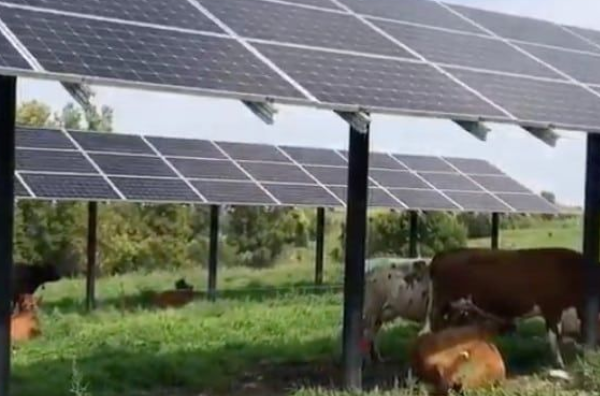
Agrivoltaics: Agrivoltaic arrays co-locate solar panels and agriculture on the same land — and they are rapidly becoming a necessity for the continued growth of AI. Just 2% of American farmland could provide 25% of the electricity needed by the United States. Solar DC Power develops agrivoltaic-powered data centers on working farmland across Georgia and the Carolinas, in partnership with independent farming families who earn income from solar leases without giving up their agricultural operations.
Bloom Energy's solid oxide fuel cells are not backup generators. They are always-on primary power sources operating continuously at the core of our microgrid systems, providing clean, firm power around the clock regardless of weather or grid conditions. Paired with agrivoltaic solar arrays and battery storage, fuel cells deliver the 24/7 reliability that data centers and critical infrastructure require. Read Bloom Energy's whitepaper on resilient microgrids to understand the technology behind our approach.
https://5242085.fs1.hubspotusercontent-na1.net/hubfs/5242085/Whitepapers/2022-Whitepaper_Resilient-Microgrids.pdf