HOME

SWITCH TO SOLAR, STOP OVERPAYING FOR YOUR ELECTRICITY
COMMERCIAL SOLAR INCENTIVES, 30% INVESTMENT TAX INCENTIVE, AND MORE UNTIL 2027
RESIDENTIAL SOLAR,
THIRD PARTY OWNERS (TPO) MAY LEASE YOUR ROOF
SEE DATA CENTER "SPAN'
MANY LOCAL INCENTIVES
The Grid Was Built for a Different Era
The American macrogrid is centralized by design. That made it efficient. It also made it vulnerable to storms, cyberattacks, rate spikes, and the sheer weight of a digital economy it was never built to carry.
Continuing to rely on the macrogrid alone is no longer viable. A single data center supporting enterprise AI draws enough power to supply 20,000 to 200,000 homes — continuously, every day. The energy appetite of artificial intelligence is not a future problem. It is here now. The macrogrid cannot keep up. Solar DC Power is building the alternative. Individually resilient. Ultimately interconnected. You cannot take down what isn't centralized.
CHANGING INCENTIVES
Act Now. The Window Is Open — But Not Indefinitely.
The landscape of solar energy incentives is rapidly evolving, bringing both new opportunities and important deadlines worth knowing. Federal subsidies for EV chargers will end June 30, 2026 — making now an ideal time to act. Beyond incentives, the economics of solar continue to improve regardless of policy. Panel costs have fallen more than 90% over the past decade, storage battery prices are following the same trajectory, and the case for energy independence grows stronger every time utility rates rise. Incentives accelerate the decision — but the fundamentals make solar the right choice with or without them.
For businesses, farmers, and rural landowners across Georgia and the Carolinas, the window to act on current incentives is open — but not indefinitely. Solar DC Power is here to help.
Homeowners considering a SolarEdge Bidirectional EV Charger have an additional opportunity worth discussing with a tax professional. A properly structured LLC may allow the owner to claim the 30% federal Investment Tax Credit on the system cost, with as little as 5% down to secure safe harbor status in the current tax year. Combined with potential first-year full depreciation under Section 179, the after-tax cost of a $12,000 to $15,000 system can be reduced substantially. Solar DC Power encourages prospective buyers to consult a qualified tax attorney or CPA to determine eligibility. The incentives are real, the window is open, and the technology is here now.
THE VISION
Distributed. Resilient. Redundant by Design
We are developing two parallel tracks of decentralized energy infrastructure across Georgia and the Carolinas — urban microgrids and rural agrivoltaic arrays — each self-sufficient, each interconnected, and together forming an energy network with no single point of failure.
Urban microgrids will grow block by block, district by district, until they form a resilient local energy web that supplements — and eventually supplants — dependence on the macrogrid. Rural agrivoltaic arrays will do the same across the open farmland of Georgia and the Carolinas, powering data centers and farming communities simultaneously. Over time, these two networks will find each other. Individually resilient. Ultimately interconnected. You cannot take down what isn't centralized.
THE DATA CENTER CRISIS: The Future
of Data Belongs in the Fields, Not the City
Something is breaking down at the heart of America's digital infrastructure. Cities are saying no. Atlanta banned new data centers near transit hubs and the Beltline. In Monroe County alone, more than 900 residents showed up to oppose a single rezoning application. Across Georgia and the Carolinas, billions of dollars in proposed data center projects have been blocked, delayed, or driven out entirely — not by bureaucracy, but by communities that simply don't want them.
The demand driving all this construction isn't slowing down. AI is accelerating. Cloud workloads are multiplying. The world needs more data capacity, not less. The question isn't whether to build — it's where.
The answer is hiding in plain sight: the open fields of rural Georgia and the Carolinas, where land is available, sunlight is abundant, and communities are ready to welcome the right kind of development.
Global data centers will more than double their electricity consumption by 2030, driven almost entirely by artificial intelligence. No energy source can scale fast enough to meet that demand except renewables. Agrivoltaics on American farmland is the most viable path forward — regardless of the policy environment in Washington.
The Efficiency Case for On-Site Generation
No Transmission Losses On-site solar generation delivers power where it is consumed. Energy that never travels the grid never loses energy to the grid.
DC-Coupled Architecture Solar panels generate DC natively. By delivering that power directly to a DC bus, we eliminate the conversion stages that waste up to 18% of total power in conventionally grid-fed data centers. https://www.utilitydive.com/news/turning-the-ac-dc-switch-learning-from-the-past-to-power-the-future/814988/
Behind-the-Meter Generation Power generated on-site is power that bypasses transmission and distribution charges entirely, turning an operating expense into a capital asset.
Agrivoltaic Cooling Reduces Thermal Load Solar arrays mounted over working farmland shade the ground, reducing ambient temperature. Cooler sites mean lower cooling costs, one of the largest operating expenses in any data center. Agrivoltaic shading reduces ground evaporation, lowering the ambient temperature and reducing the cooling water demand that conventional data centers require in large volumes.
Source: "Turning the AC-DC Switch," Utility Dive, April 7, 2026
HOW WE BUILD RESILIENCE
Solid oxide fuel cells are not backup generators. They are always-on primary power sources operating continuously at the core of our microgrid systems, providing clean, firm power around the clock regardless of weather or grid conditions. Paired with agrivoltaic solar arrays and battery storage, fuel cells deliver the 24/7 reliability that data centers and critical infrastructure require. Read Bloom Energy's whitepaper on resilient microgrids to understand the technology behind our approach.
AGRIVOLTAICS
MICROGRIDS
Where Clean Energy Meets Working Land
Agrivoltaics is the co-location of solar panels and agriculture on the same land — and it is rapidly becoming a necessity for the continued growth of AI. Agrivoltaic arrays on less than 1% of American farmland could meet 20% of the country's total electricity generation. That land is already flat, already cleared, already sun-exposed, and already in private hands. It is the only path that can scale fast enough to meet AI's energy appetite without triggering the community opposition that is already blocking conventional data center development.
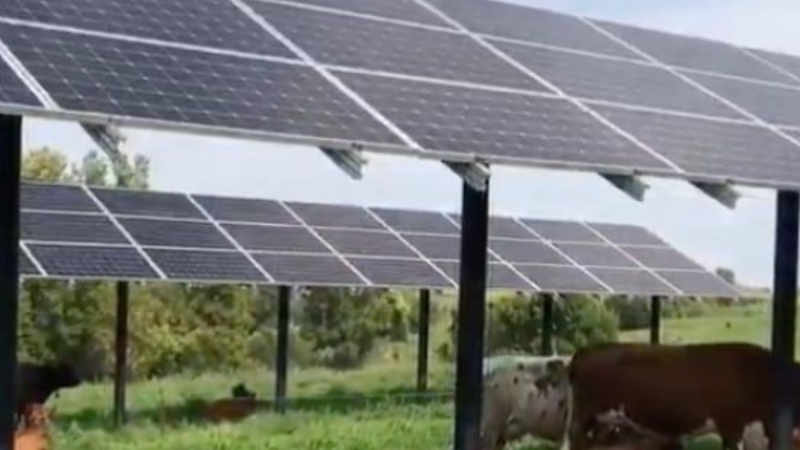
Solar DC Power develops agrivoltaic-powered data centers on working farmland across Georgia and the Carolinas. Solar panels are elevated high enough for tractors to pass beneath them, livestock to graze under them, and crops to grow alongside them. The farm keeps farming. The solar array powers the data center. The farmer earns income from both — often more than six times what traditional land rental would pay.
The Urban Counterpart
In cities and towns, microgrids are the answer. A microgrid is a self-contained local energy system that can operate independently from the macrogrid — or connect to it when advantageous. As urban microgrids multiply and interconnect across neighborhoods and districts, they form exactly the kind of distributed, resilient energy infrastructure that neither storms nor cyberattacks can take down with a single strike.
Solar DC Power develops microgrid solutions for urban and suburban clients across the Southeast — the urban counterpart to our rural agrivoltaic work, and the other half of a vision for true, sustainable, energy independence.
SECURITY
Decentralized Energy Is Secure Energy
A centralized grid is a single target. A network of distributed microgrids and agrivoltaic arrays is not. There is no master switch. No central node to attack or disable. For enterprise data center operators, that means 24/7 operational continuity. For farming communities, it means energy that belongs to them — not to a utility three states away. For the nation, it means critical digital infrastructure hardened not by walls, but by architecture.
This is the security argument that no one else in this industry is making. Solar DC Power is making it — and building it.
FARMER PARTNERSHIP
Built With Farmers, Not Over Them
Every Solar DC Power site will be developed in partnership with independent farming families. Solar lease rates of $1,000 or more per acre annually — compared to the Georgia average of just $153 per acre for traditional cash rent. And you don't give up farming to participate. The panels go up. The crops keep growing. The livestock keep grazing. Your land stays yours.
Agrivoltaic farming also eliminates the hidden costs that quietly erode farm profitability — no transgenic seed purchases, no RoundUp, no herbicide application labor or equipment. Healthier soil. Cleaner food. A more viable farm — for this generation and the next.
Why Choose Solar DC Power
There are plenty of solar companies in the Southeast. There are data center operators, too. But there isn't another company in this region - or honestly, in the country - doing what Solar DC Power does: combining solar energy, Agrivoltaic farming, farmer partnership economics, and data center infrastructure into a single, integrated offering. That's not a marketing claim. It's a gap in the market that we're built to fill.
We're regionally rooted, which means we understand the land, the communities, and the regulatory landscape across Georgia, North Carolina, and South Carolina in a way that a national firm parachuting in simply can't. We know which counties are pro-development and which ones need a different conversation. We know the farmers. We know the fiber corridors. And we know how to build trust before we break ground.
What we're building here isn't just infrastructure — it's a different relationship between digital technology and the land it depends on. We believe data centers can be a force for rural renewal rather than displacement.
LAND LEGACY
Georgia and the Carolinas Were Built by People
Who Understood That Land Is a Legacy
Generations of farming families have worked this soil, shaped these communities, and built something worth protecting. Solar DC Power is building an infrastructure future that honors that legacy rather than competing with it.
Data centers that power the digital economy. Agrivoltaic Solar arrays that power the data centers. Farms that power the community. None of it at the expense of the land, the farmer, or what comes next.
We are still early. The sites are being developed. The partnerships are being formed. There is room for the right businesses and the right landowners to be part of building this from the ground up.
If that sounds like something you want to be part of — we would like to talk.